
The index has posted below the 50 mark, which marks contraction, for the third consecutive month.

For the April-February period of 2012-13 fiscal, the industrial production growth is at 0.9 per cent, down from 3.5 per cent in the same period of 2011-12, according to official data released on Friday.

Industrial growth, as measured by Index of Industrial Production slowed to 2.7 per cent in August, from 3.4 per cent in the corresponding period last year.
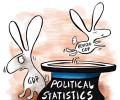
The GDP growth is estimated to come at the "deceptively high" level of 20 per cent for the April-June 2021 quarter but is far below the same in the pre-COVID times, rating agency Icra said on Wednesday. Icra said the low base of the last year, when the GDP had contracted by close to 24 per cent, "conceals" the impact of the second wave of COVID-19 infections. Economic activity is boosted by robust government capital expenditure, merchandise exports and demand from the farm sector, it said, estimating the GDP to grow by 20 per cent and the gross value added (GVA) will register a growth of 17 per cent for the June quarter.

Official sources said such norms form the benchmark of costing, which helps in working out the price of inputs required for manufacturing or producing a certain quantity of output.

Workers moving out of agriculture to the rural labour force were largely getting absorbed in construction activities

To be able to tide over the current crisis, automobile manufacturers have waged a war against all cost heads.

So vaccinate employees and families, staff at home, rickshaw drivers, milkmen, service providers, shopkeepers and street vendors, says Naushad Forbes.

Harley Davidson, KTM-Bajaj, M&M make India production base for automobiles to be assembled and sold in China.

'The China opportunity, the digital opportunity and the end of geography opportunity are the three pieces of luck India got due to Covid.'

The eight core industries -- fertilisers, cement, steel, electricity, crude oil, coal, petroleum refinery products and natural gas -- have a combined weight of about 38 per cent in the Index of Industrial Production.

Although the country's manufacturing growth rate fell to its lowest in over four years last month, the export orders picked up and both input and output inflation eased, as per a monthly Purchasing Manager survey conducted by HSBC India and financial information provider Markit.


India has one thing that China has - the potential to be of interest as a huge market in its own right.

The HSBC Emerging Markets Index, a monthly indicator derived from the PMI surveys, inched up to 50.4 in April, from 50.3 in March, signalling only a marginal increase in output across global emerging markets in April.

'Much of the Socialism that we attribute to him actually came during Indira Gandhi's time,' says M J Akbar who believes that Nehru's convictions helped shape modern India.

Internal management tensions, stiff opposition from Chinese handset makers led to halving of the company's market share
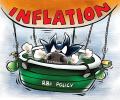
The Reserve Bank of India on Friday raised the retail inflation forecast for 2021-22 to 5.7 per cent due to supply side constraints, high crude oil and raw materials cost. The RBI in June had pegged the retail inflation estimate at 5.1 per cent for the current financial year. The RBI has the mandate to keep inflation in a band of 2-4 per cent, with a tolerance level of 2 per cent on either side.

Department of Economic Affairs secretary Atanu Chakraborty said that equity capital flows have been positive this year.

The minister said that the priority for him will be "rolling out all stuck highway projects that include many of the IL&FS projects within 100 days".

It indicates that the economy has remained frail at the start of the new fiscal year.
Continuing its dismal performance, industrial growth fell further to 1.9 per cent in September, mainly due to poor output from the manufacturing sector.

BSE market breadth was negative. Out of 2,961 shares traded, 1,907 shares declined while 941 shares advanced.

We analysed the smartphone on several parameters to test its overall capabilities.
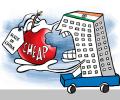
We import from China not because we love China, but because they sell us these things at cheap prices, points out Rathin Roy.
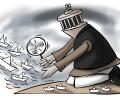
Chief Economic Advisor Krishnamurthy Subramanian said China imports a lot of components, parts, assembles and integrates and then exports them.

This is mainly due to GST impact on manufacturing and subdued farm output.

The absence of any recovery in investment is underlined by the capital goods sector.

Finance Minister Nirmala Sitharaman on Thursday announced a new job creation scheme by giving subsidy to those establishments that make new hires. The subsidy would be to cover for retirement fund contributions by employees as well as employers for two years, she said. Employees contribution (12 per cent of wages) and employer's contribution (12 per cent of wages) totalling 24 per cent of wages would be given to establishments for two years, she said. Under the Aatmanirbhar Bharat Rozgar Yojana, every Employees' Provident Fund Organisation (EPFO)-registered establishment taking new employees would get this subsidy.

In his monthly Mann ki Baat broadcast, Modi noted that the country was also faced with several natural disasters, including cyclones, landslide and earthquakes, during the pandemic, and said more lives were saved than the past with the Centre, states and local administration coming together to carry out relief and rescue operations.

The Nikkei India Services Purchasing Managers' Index, which tracks the services sector firms on a monthly basis, stood at 50.3 in February, up from 48.7 registered in January.

During the April-July period of this fiscal, IIP growth stood at 5.8 per cent, as against 9.7 per cent in the corresponding four-month period last year.

How soon can India reach a point when there is no hidden underemployment and all who want work can find it at a fair wage and decent work conditions, asks Nitin Desai.

The meeting comes against the backdrop of negative growth in the manufacturing sector. In July, the country's overall industrial output expanded by just 0.1 per cent cent -- as against 3.7 per cent in the same month last year -- pulled down by decline in manufacturing sector growth.

Maharashtra's "radical" lockdown move will have an economic impact of Rs 40,000 crore, with the trade, hotels and transport sector to bear the biggest dent, Care Ratings said on Monday. The rating agency said the loss of economic activity will have a 0.32 per cent impact on the gross value added (GVA) growth at the national level. It revised down its national GDP growth estimate to 10.7 - 10.9 per cent from the 11 - 11.2 per cent given a week ago. Maharashtra has been contributing nearly 60 per cent to the daily COVID-19 infections nationally and had over 57,000 new cases on Sunday.
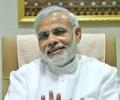
The headline HSBC Services Business Activity Index was at a 17-month peak of 54.4 in June rising from a modest 50.2 in May, HSBC said adding that 'the Modi wave has struck the service sector'.

Tata Motors has halved the volume outlook for its UK subsidiary Jaguar Land Rover Automotive (JLR) and warned of lower earnings as it sees the semiconductor shortage deepening in the September quarter of the current financial year, according to a notification issued by the company to the stock exchanges on Tuesday. The announcement caught investors unawares. They were hoping for a quicker recovery. Tata Motors' stock tanked 13 per cent (on July 6) from the day's high of Rs 358.10 and hit the lower circuit (Rs 311.45) in intra-day trades.
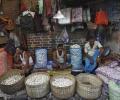
India's wholesale prices declined at a faster-than-expected annual rate of 2.33 per cent in March.

The index went below the crucial 50 mark.

On the job front, Indian service providers continued to add to their payrolls and the sector witnessed the second-strongest increase in employment since March 2011.
